I once promoted a course on “How to Make Money Online.” The creator promised that anyone could become a millionaire in 30 days. I knew, deep down, that it was mostly hype. But the affiliate commission was $100 per sale.
I thought, “I need the money. And technically, the course exists. It’s not a total scam.”
I sent the email. I made $500 that day. But when a reader replied and said, “I spent my last savings on this because I trust you,” I didn’t feel rich. I felt sick.
I realized I wasn’t a marketer anymore. I was a liar for hire.
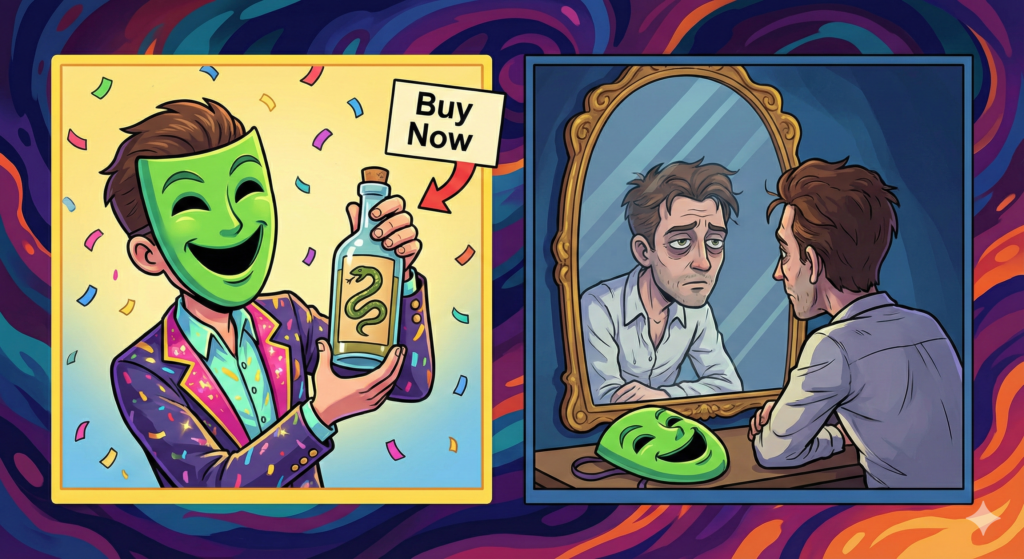
This is the Dark Side of affiliate marketing. It is the slippery slope where “persuasion” turns into “deception.” And if you aren’t careful, you can lose your soul for a paycheck.
There is a popular strategy in the affiliate world called “Churn and Burn.”
The idea is simple:
- Find a terrible product that pays huge commissions (like diet pills or “get rich quick” schemes).
- Lie about how great it is to get quick sales.
- When people realize it’s junk and get angry, disappear and start a new website with a new name.
It works. You can make money this way. But it is a miserable way to live. You are constantly running, hiding and starting over. You never build a brand. You never build trust. You are just a digital con artist.
If you want to sleep well at night, watch out for these common traps. “Gurus” will tell you these are smart marketing tactics. They are not. They are lies.
1.Timer Scam
You land on a page and see a timer counting down: “Offer ends in 5 minutes!” You panic and buy. Then, you refresh the page… and the timer starts over at 5 minutes.
This treats your customers like idiots. Once they realize the timer is fake, they will never trust you again.
2. I Use It Every Day Scam
A YouTuber holds up a brand new item. The box is clearly unopened. They say, “I use this every morning!”
Don’t say you use it if you don’t. It is okay to say, “I haven’t tested this personally, but the specs look good.” Honesty is better than a fake endorsement.
3. Blind Recommendations
This is when you recommend a product just because it pays the most.
- Example: Promoting “Bad Host A” because they pay $100, instead of “Good Host B” who pays $50.
Your recommendation is your reputation. If you sell your reputation for an extra $50, you are selling it too cheap.
So, how do you stay on the Light Side? How do you make money without feeling gross?
I use a simple filter called The Grandma Test.
Before I post an affiliate link, I imagine my Grandma is the one clicking it.
- If she bought this product based on my recommendation, would she be happy?
- Or would she call me a week later, confused and upset because she wasted her pension money?
If I wouldn’t sell it to my Grandma, I won’t sell it to my readers.
Here is the irony. The “Dark Side” is faster, but the “Light Side” is richer.
When you are brutally honest, people become obsessed with you. If you write a review and say: “Honestly, this software is kinda hard to use. The support is slow. But if you need this one specific feature, it is the best option.”
People think: “Wow, he isn’t trying to trick me.”
They will bookmark your site. They will subscribe to your email list. They will buy the next thing you recommend because they know you aren’t a liar.
Trust is a snowball. It starts small, but it rolls downhill and gets massive. The “Dark Side” marketers never get to see the snowball because they melt it for quick cash every day.
Clean Money Tastes Better
That $500 I made from the bad course? I spent it on bills and it was gone. But the guilt stayed for years.
Today, I make less money on some sales because I recommend cheaper, better products. But when I get an email saying, “Thanks for the recommendation, I love it!” that feels like success.
You are building a business, not a heist. Build something you can show your family. Build something real.
Marketing isn’t about tricking people into opening their wallets. It’s about helping them solve a problem so well that they are happy to pay you for it.