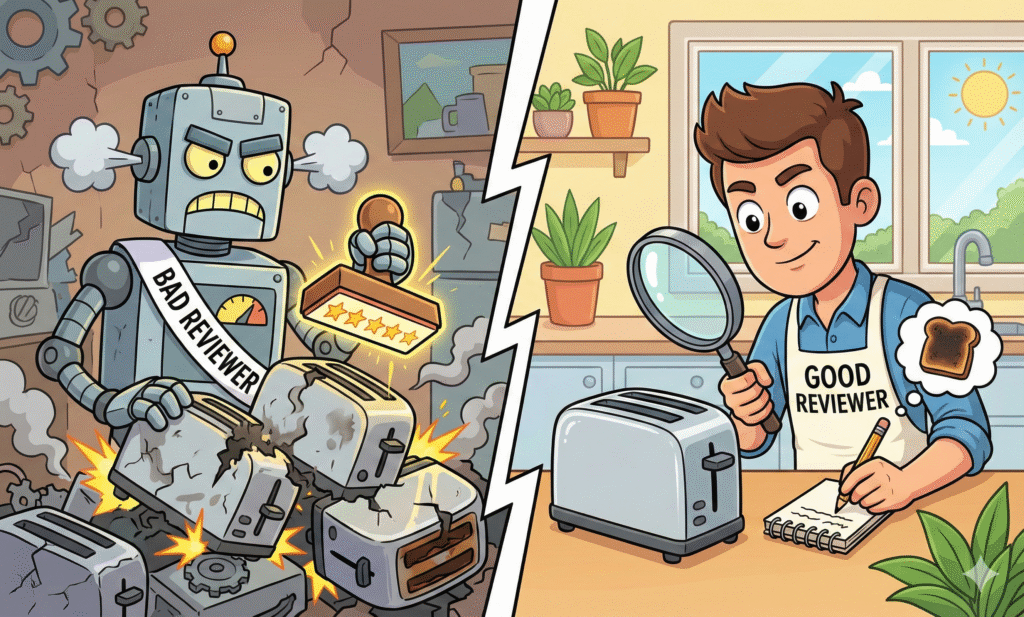
Last year, a company emailed me. They wanted me to review their new vacuum cleaner. They said: “We will pay you $500 if you give it a 5-star review.”
I was broke. I looked at the $500. I looked at the vacuum. I said yes.
They sent the vacuum. I opened the box. It felt like cheap plastic. I turned it on and it sounded like a dying airplane. It didn’t pick up dirt, it just pushed the dirt around the room.
It was garbage.
I sat at my computer to write the review. I typed: “This is the best vacuum ever!” But my fingers stopped. I couldn’t do it. I imagined my readers buying this junk because of me. I imagined them getting angry.
I sent the vacuum back. I turned down the $500.
It hurt my wallet, but it saved my soul. And it taught me the most important lesson in marketing: Trust is expensive. Don’t sell it for cheap.
Think about the last time you bought something on Amazon. You see a product with 10,000 reviews and 5.0 Stars.
Do you believe it? No. You think, “These are fake bots.”
Now, imagine you see a product with 4.5 Stars.
- One person says: “It works great, but the cord is a little short.”
- Another says: “The color is darker than the picture, but it’s sturdy.”
Boom. You buy it. Why? Because the flaws make it feel real.
If you tell your readers that a product is perfect, they know you are lying. If you tell them it has flaws, they believe you when you say it’s good.
This is my secret weapon for writing reviews that actually make money.
Most bloggers just want everyone to buy the product. So they say, “This is great for everyone!”
Don’t do that.
In every review, include a bold section called: “Who is this NOT for?”
- Example (Running Shoes):“If you have wide feet, do NOT buy these shoes. They are very narrow. You will get blisters. But if you have narrow feet, they fit like a glove.”
Why this works:
- It saves you from refunds: The people with wide feet won’t buy it (and won’t return it).
- It sells the right people: The people with narrow feet think, “Aha! This was made exactly for me!” and they hit the buy button instantly.
Boring reviewers copy the features box.
- “It has a 400-watt motor.”
- “It weighs 2 pounds.”
- “It is blue.”
Yawn. I can read that on the Amazon page. I came to your blog for your experience.
Tell me the Benefit, not the Feature.
- Don’t say: “It has a 12-hour battery.”
- Say: “I took this on a flight from London to New York, watched three movies and it still had power left when I landed.”
Stories sell. Specs do not.
If you use the shiny, perfect professional photos from the company website, your blog looks like an ad.
Take your own photos.
- Take a picture of the product on your messy desk.
- Take a picture of you holding it.
- Take a picture of the scratch on the side.
People want Proof of Life. They want to know that you actually touched the object. An ugly photo taken with your iPhone is worth 100 times more than a perfect studio shot.
Be the Friend, Not the Salesman
Imagine your best friend asks you if they should watch a new movie. You wouldn’t say, “It is a 120-minute visual masterpiece with 5 stars!”
You would say: “It was pretty good! The ending was a bit slow, but the action scenes were awesome. You should see it.”
That is a review.
Stop trying to be a “Professional Reviewer.” Just be a friend who refuses to let your friends buy garbage.
If a product sucks, say it sucks. If a product is good, say it’s good.